
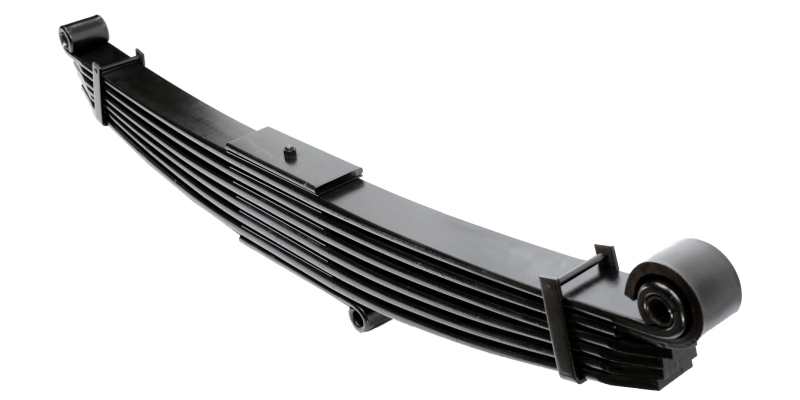
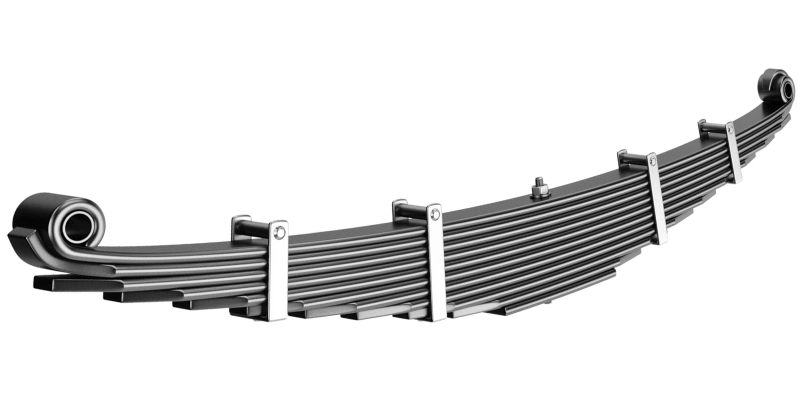
A trusted Parabolic Leaf Spring manufacturer
With a legacy spanning 25+ years, Royal Spring Industries stands out as a trusted Parabolic Leaf Spring manufactures, certified with ISO 9001:2015 for quality control, the company is committed to delivering high-quality products that meet global standard.
Our company specializes in the production of Parabolic Leaf Spring tailored for both Railway Bogie suspension systems and Automobile suspension systems. Our expertise allows us to craft Leaf Spring in a range of sizes, from the smallest to the most heavy-duty configurations, ensuring we meet the diverse needs of our clients.
We are Parabolic Leaf Spring manufacturer up to the following capacity :
- Flat Thickness : Up to 20 mm.
- Flat Width : Up to 250 mm.
- Total Length : As per Drawing / required
- Total Height : As per Drawing / required
- Raw material : Any Spring Steel grades according to load requirement & functionality
Parabolic Leaf Spring vs Semi-Elliptical Leaf Spring
When evaluating the differences between Parabolic Leaf Spring and Semi-Elliptical Leaf Spring, it is essential to consider various criteria that impact their performance and suitability for specific applications.
Parabolic Leaf Spring is designed with tapered leaves that reduce weight, minimize friction and provide better ride comfort. They are ideal for vehicles where comfort and reduced unsprung weight are important. Whereas, Semi-Elliptical Leaf Spring uses multiple uniform-thickness leaves, making them stronger and better suited for heavy-load applications. Although this spring is more economical and durable under heavy loads, Parabolic Springs offer superior comfort, lower maintenance and improved fuel efficiency.
Below is a detailed comparison that outlines their features and benefits :
| Feature | Parabolic Leaf Spring | Semi-Elliptical Leaf Spring |
|---|---|---|
| Construction | Made of fewer leaves with variable thickness (thicker at the center and thinner at the ends). | Consists of multiple leaves of uniform thickness stacked together. |
| Weight | Lighter due to fewer leaves. | Heavier because of multiple steel leaves. |
| Ride comfort | Provides a smoother and more comfortable ride due to reduced inter leaf friction. | Offers a comparatively stiffer ride because of higher inter leaf friction. |
| Load carrying Capacity | Suitable for moderate loads; may have lower load capacity than conventional springs. | Excellent for carrying heavy loads and widely used in commercial vehicles. |
| Friction | Minimal inter leaf contact, resulting in lower friction and reduced wear. | High inter leaf friction, which helps damp vibrations but increases wear. |
| Durability | Good fatigue life with proper design but can be more sensitive to overloading. | Highly durable and capable of withstanding rough operating conditions. |
| Maintenance | Requires less maintenance due to fewer leaves and lower wear. | Requires more maintenance because of wear between the leaves. |
| Cost | More expensive due to advanced manufacturing and material requirements. | Less expensive and easier to manufacture. |
| Applications | Commonly used in modern passenger cars, SUVs and light commercial vehicles. | Widely used in trucks, buses, trailers, and heavy-duty vehicles. |
| Fuel efficiency | Improves fuel efficiency because of lower weight. | Slightly reduces fuel efficiency due to greater weight. |
Parabolic Leaf Spring Pros and Cons
Advantages of Parabolic Leaf Spring :
Parabolic Leaf Spring have gained popularity in automotive design and suspension systems due to their numerous advantages over traditional Multi-Leaf Springs. One of the foremost benefits is their significant weight reduction. Comprising fewer leaves, Parabolic Leaf Springs are lighter, which ultimately contributes to improved vehicle fuel efficiency and overall performance. The decreased weight leads to less strain on the vehicle’s chassis and enhances the lateral dynamics of driving, rendering it more agile on the road.
Another benefit of Parabolic Leaf Spring is their superior flexibility. The tapered design allows these springs to articulate more efficiently, providing a more responsive tuning of suspension dynamics. This enhanced flexibility results in improved vehicle handling by allowing the wheels to work independently. Consequently, this contributes to better traction and stability, especially in uneven terrain or during abrupt directional changes.
Furthermore, Parabolic Leaf Spring significantly enhance ride comfort. Their design absorbs road imperfections more effectively than their Multi-Leaf counterparts, providing a smoother driving experience. Passengers are likely to notice reduced cabin vibrations and jarring effects from surface irregularities, which is particularly important for long journeys. Additionally, these Springs distribute loads more evenly across the axle, minimizing the risk of sagging and promoting longer service life for the suspension system.
Disadvantages of Parabolic Leaf Spring :
Parabolic Leaf Spring, while offering numerous advantages, also present several disadvantages that potential users must consider. One major drawback is their higher manufacturing costs. The complexity involved in producing parabolic Leaf Spring results in elevated expenses compared to traditional Leaf Spring. Many manufacturers invest more time and resources into the design and fabrication processes, ultimately leading to increased retail prices for consumers. Thus, those on a budget may find it challenging to justify the additional costs associated with parabolic designs.
Moreover, compatibility issues can complicate the adoption of Parabolic Leaf Spring. While they are designed to fit various vehicle models, some specific makes or models may not accommodate parabolic systems due to differences in suspension layouts. This can create a scenario where vehicle owners are unable to upgrade their suspension systems without incurring further modifications or costs. If the vehicle’s mounting points or geometry require alteration, it can lead to additional labor and expenses that diminish the overall value of upgrading to this Springs.
Lastly, concerns regarding durability can emerge, especially in extreme applications. Although Parabolic Leaf Springs are engineered to offer enhanced performance and comfort, there exist concerns about their longevity under heavy loads or in severe off-road settings. Some users may find that the Spring do not hold up as well as traditional Leaf Springs in rigorous conditions, potentially leading to premature wear and the need for replacements. As such, it is essential for potential users to weigh these considerations against the advantages when deciding if this Springs are the right choice for their specific needs.